Research Publications
Learning correlated astrophysical foregrounds with denoising diffusion probabilistic models
K. Prabhu Palimar, S. Raghunathan, E. Anderes, L. Knox
Journal of Cosmology and Astroparticle Physics (JCAP), 09 (2025) 012
Journal · arXiv:2506.09036
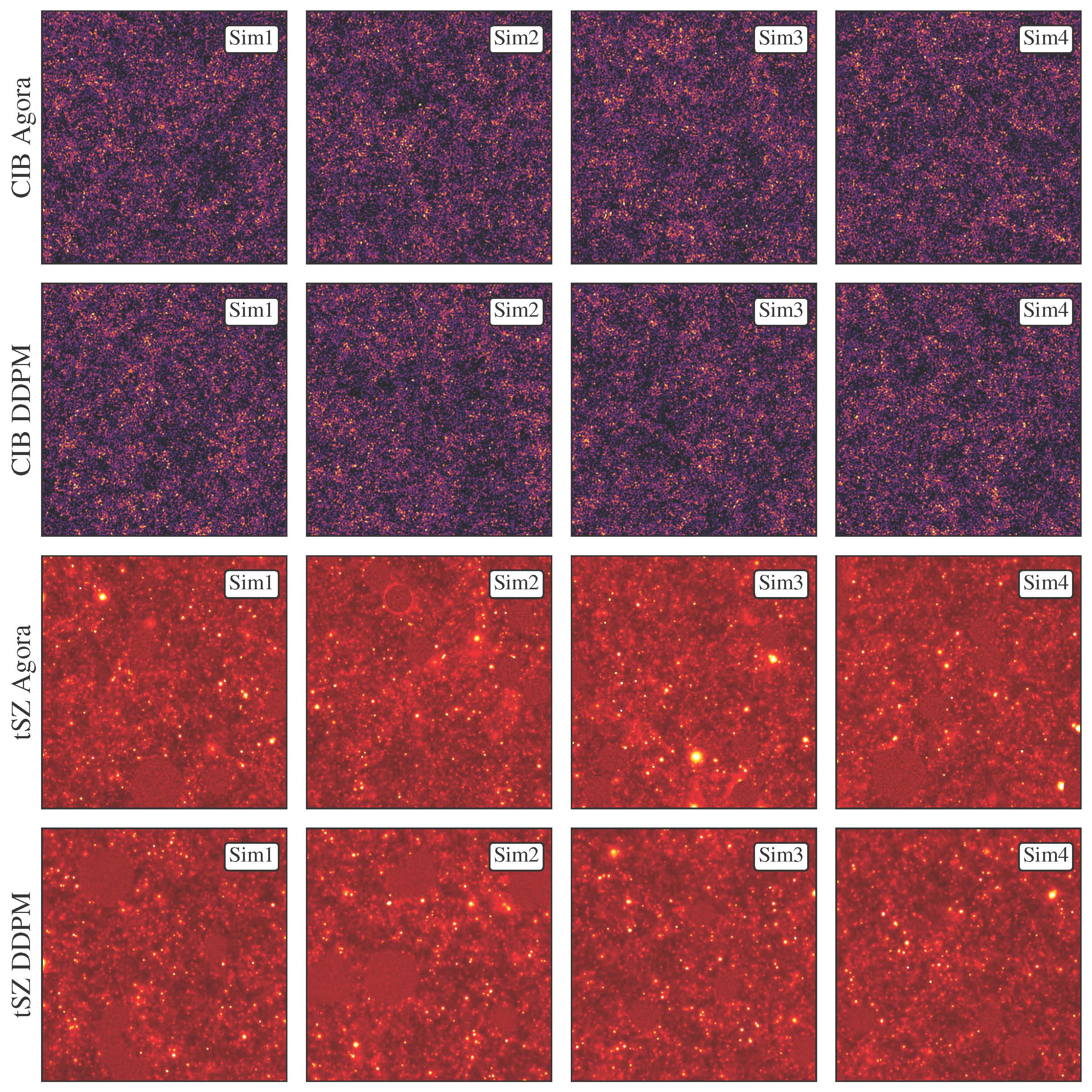
Extragalactic foregrounds such as the Cosmic Infrared Background (CIB) and thermal Sunyaev-Zel’dovich (tSZ) effect have highly non-Gaussian structure and correlations that can bias small-scale CMB analyses. In this work we train denoising diffusion probabilistic models (DDPMs) on paired CIB–tSZ patches from the Agora simulations to learn their full joint distribution. The trained models generate fast, realistic foreground maps that reproduce auto- and cross-spectra, higher-order statistics, and Minkowski functionals, providing a path toward forward-modelling correlated extragalactic foregrounds in CMB lensing pipelines.
Role: Led the project and model development, including DDPM architecture choices, training/evaluation pipeline, and cosmology validation tests.
Testing the ()CDM cosmological model with forthcoming measurements of the CMB with SPT-3G
K. Prabhu Palimar et al.
The Astrophysical Journal, 973 (2024) 4
Journal · arXiv:2403.17925
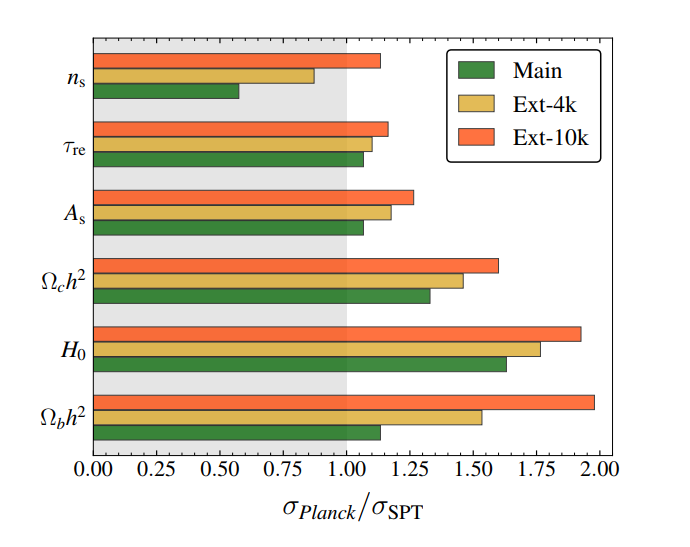
We forecast cosmological parameter constraints from three SPT-3G surveys covering a combined 25% of the sky at multiple frequencies and depths. Using a novel approach to jointly model the covariance of CMB temperature, polarization, and lensing potential bandpowers, we test ()CDM via the consistency of parameters constrained independently from SPT-3G and Planck. We also quantify the improvement on ()CDM extension parameters from a combined SPT-3G + Planck analysis, finding uncertainties up to roughly a factor of two smaller than Planck alone while probing complementary angular scales and polarization levels.
Role: Lead author on the forecasting pipeline and covariance framework, responsible for parameter-forecast machinery, bandpower covariances, and consistency tests between SPT-3G and Planck.
A generative model of Galactic dust emission using variational autoencoders
B. Thorne, L. Knox, K. Prabhu Palimar
Monthly Notices of the Royal Astronomical Society (MNRAS), 504 (2021) 2603–2613
Journal · arXiv:2101.11181
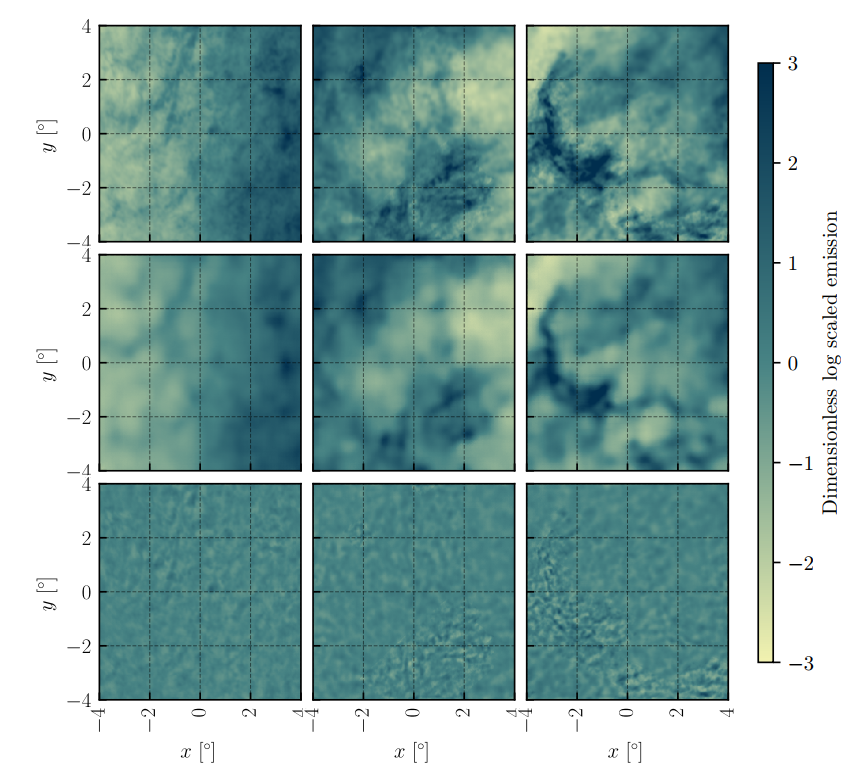
We apply variational autoencoders (VAEs) to maps of Galactic dust emission inferred from Planck data to build a generative model of the dust intensity field. The trained VAE can generate new dust realizations that match key summary statistics of the training maps, fit withheld maps, and produce constrained realizations conditioned on observations. This work demonstrates that deep generative models can capture the non-Gaussian structure of Galactic dust in a way that is useful for CMB foreground modelling and experimental design.
Role: Contributed to model development, training and evaluation strategy, and analysis of how VAE-generated maps reproduce dust statistics relevant for CMB foreground studies.